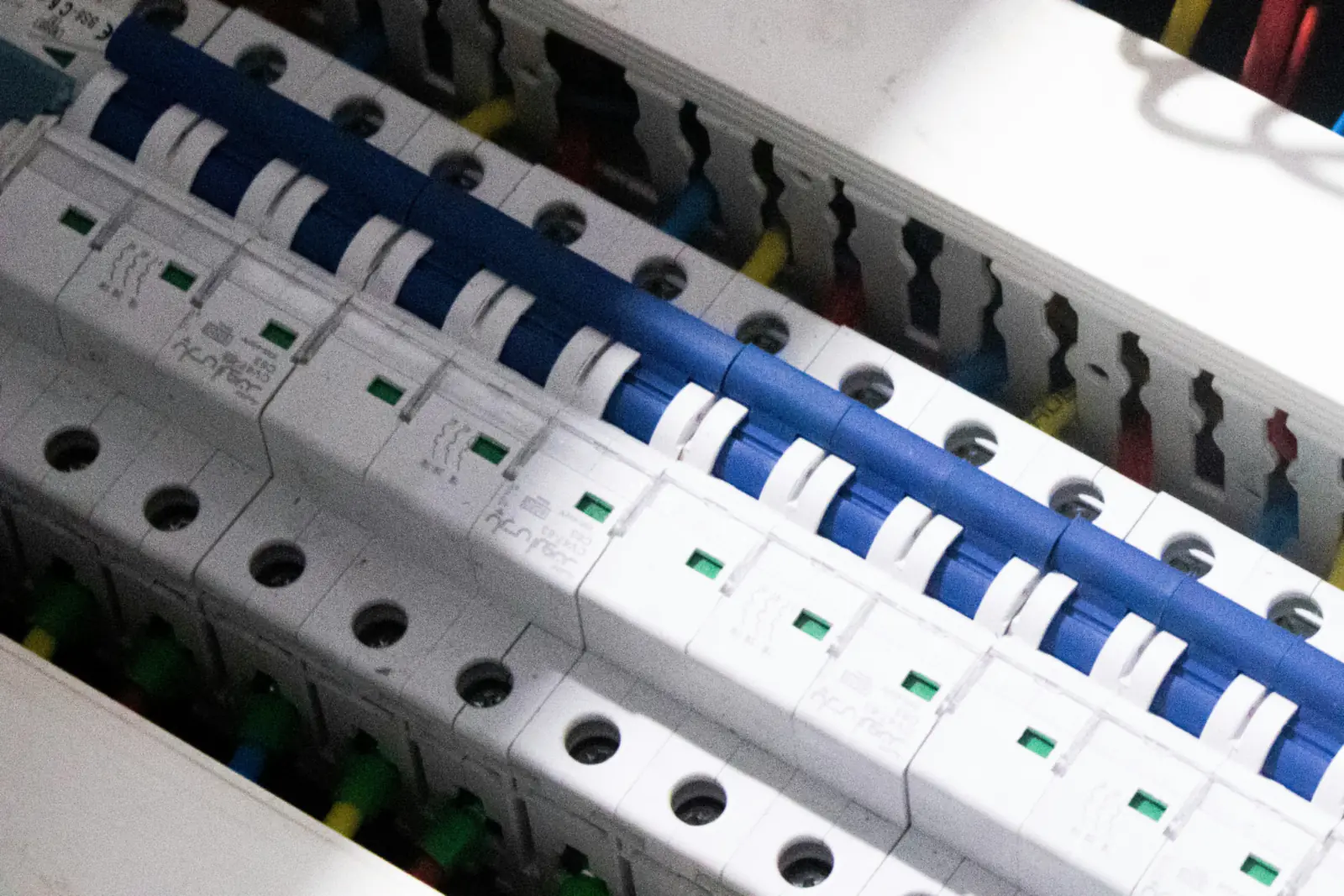
Molded case circuit breakers (MCCBs) protect feeders, motor circuits, panelboards and equipment across every industrial site and data center. When one fails, is damaged or needs to be added to a panel, the right replacement is rarely “anything with the same amps”. Breakers are designed and listed as part of a system, and several ratings have to line up. This guide walks through the label and then the replacement.
Key takeaways
- Frame size is the breaker family and its maximum current; the trip rating is what this breaker actually protects at.
- The interrupting rating (kA at a stated voltage) must be at least the available fault current where the breaker is installed.
- Check the voltage rating carefully: a slash rating such as 480Y/277 V is only for solidly grounded wye systems.
- A replacement must be listed or classified for the panel it goes in, with the same mounting and a suitable trip unit.
- Changing trip ratings or settings is a design decision, not a like-for-like swap.
Safety first: breakers are installed in energized equipment. Replacing one is work for qualified personnel only, with the equipment de-energized under your lockout/tagout procedure, appropriate PPE for the arc-flash hazard, and absence of voltage verified before work begins.
Reading the label
Frame and frame size
The frame is the breaker's physical and electrical family – its case size, mechanism and maximum current. Manufacturers name frames with letters (Eaton and Cutler-Hammer use names such as EHD, FD and HFD; Square D, Siemens, ABB and GE have their own schemes), and each frame is available in a range of amp ratings up to its frame size – for example, a 100 A, 225 A or 400 A frame. Two breakers in the same frame share dimensions and accessories; two different frames usually don't.
Catalog numbers typically combine the frame, the number of poles and the amp rating, sometimes with letters for terminals or options. On many Eaton breakers, HFD3100 reads as frame HFD, 3 poles and 100 A. Always decode a catalog number with the manufacturer's guide – the order and meaning of the fields vary.
Trip rating (ampere rating)
The trip rating is the continuous current the breaker carries without tripping; above it, the trip unit opens the breaker after a delay that gets shorter as the overload grows. It is chosen to protect the conductors and equipment on that circuit. A standard breaker is generally applied so the continuous load does not exceed 80% of its rating; 100%-rated breakers can carry their full rating continuously, but only when installed in an assembly and with conductors that meet the listing's conditions.
Trip unit type
- Thermal-magnetic – a thermal element for overloads and a magnetic element for short circuits. Common in smaller frames; some have an adjustable instantaneous (magnetic) setting.
- Electronic – current sensors and a trip unit with adjustable settings, commonly long-time, short-time, instantaneous and ground-fault functions. Common in larger frames.
- Fixed or interchangeable – some frames accept different trip units or rating plugs, so the same frame can be set up for different ratings.
- Magnetic-only (motor circuit protectors) – instantaneous-only breakers used with a motor starter's overload relay for motor branch circuits.
Interrupting rating (kA)
The interrupting rating (often called AIC or kAIC) is the highest fault current the breaker can safely interrupt, stated in kiloamps at a specific voltage. The same breaker usually has a lower interrupting rating at a higher voltage, so read the value for your system voltage. The rule is simple: the interrupting rating must be at least the available fault current at the point of installation. Manufacturers often offer the same frame in standard, high and very high interrupting versions, which look almost identical – the letters in the catalog number and the label tell them apart.
Voltage rating: straight or slash
A straight voltage rating such as 480 V means the breaker can be applied on any 480 V system. A slash rating such as 480Y/277 V or 120/240 V means it can only be applied where no pole sees more than the lower voltage to ground – in practice, a solidly grounded wye system for 480Y/277 V. Putting a slash-rated breaker on a delta or ungrounded system is a misapplication.
Poles, mounting and terminals
Match the number of poles (1, 2, 3 or 4), the mounting (bolt-on, plug-in, a panelboard-specific connection, rear-connected or drawout) and the terminals – line and load lugs sized for the conductors you have, or bus connections.
Standards and listing
In North America, MCCBs used for branch-circuit and feeder protection are listed to UL 489. Supplementary protectors, listed to UL 1077, look similar – especially on DIN rail – but are not a substitute for a branch-circuit breaker.
Finding a replacement: a checklist
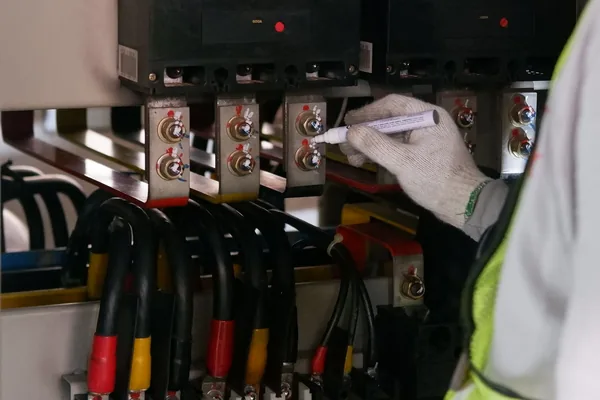
- Photograph the label and the whole breaker, including lugs and accessories.
- Same manufacturer and frame family wherever possible. Panelboards and switchboards are tested with specific breaker types; a different breaker must be listed or classified for that equipment. The equipment's label and documentation say what is allowed.
- Same trip rating and trip unit type, with the same settings on adjustable units. Don't increase the rating to stop nuisance trips – find the cause.
- Interrupting rating equal or higher, at your voltage.
- Voltage rating suitable for the system, straight or slash.
- Same poles, mounting and terminals.
- Accessories: shunt trip, undervoltage release, auxiliary and alarm switches, handle mechanisms and padlock attachments. Check the coil voltage of shunt trips and undervoltage releases.
- Series ratings. If the panel relies on a tested series combination of upstream and downstream devices, the replacement must be one of the combinations listed on the equipment label.
- Coordination and arc flash. Changing trip type or settings can affect selective coordination and the site's arc-flash study. Involve whoever owns those studies.
Buying breakers as surplus
Surplus is often the fastest source for breakers from older panel lines and for frames with long lead times. Look for photos of the actual unit that show the label, the lugs and any accessories, and check for signs of heat, cracks or damage to the case. A breaker that has interrupted a large fault or shows physical damage should not be reused. Look at the date code and ask how the breaker was stored and whether it was tested.
Browse molded case circuit breakers, miniature and DIN-rail breakers and breaker accessories, or search by the exact catalog number. Common brands on our shelves include Square D, Cutler-Hammer, Eaton, General Electric, Siemens and Westinghouse. If the frame you need isn't listed, ask for a quote and we'll look.
Frequently asked questions
What is the difference between frame size and trip rating?
The frame is the breaker's physical and electrical family and sets the maximum current it can be built for. The trip rating is the continuous current at which that particular breaker is set or built to trip, which can be lower than the frame rating.
What does the interrupting rating mean?
The highest fault current, in kA at a stated voltage, that the breaker can safely interrupt. It must be at least the available fault current where the breaker is installed.
Can I use a breaker from a different manufacturer in my panel?
Only if it is listed or classified for that panelboard or switchboard. Panels are tested with specific breaker types; check the panel's label and documentation before substituting.
Can I replace a breaker with a higher amp rating?
Not simply to stop nuisance trips. The trip rating protects the conductors and equipment on that circuit; changing it is a design decision for a qualified person, not a like-for-like replacement.