Most drive-sizing mistakes start with one number: horsepower. Two motors of the same horsepower can draw noticeably different currents, run at different speeds and tolerate different overloads, and a drive only cares about current, voltage and duty. This guide covers the nameplate fields that matter and a step-by-step way to choose a replacement drive. For how drives work and fail, see VFD basics for maintenance teams.
Key takeaways
- Size the drive by the motor's full-load amps (FLA) at your voltage, then by duty; horsepower or kW is only a starting point.
- Match the input: supply voltage class, three-phase or single-phase, and the available fault current.
- Derate for heat, altitude, carrier frequency and single-phase input using the curves in the drive's manual.
- Enter the nameplate data into the drive's motor parameters – protection and motor control depend on it.
Reading the motor nameplate
| Field | What it tells you |
|---|---|
| HP or kW | Rated output power at the shaft |
| Volts | Rated voltage; dual-voltage motors show two, such as 230/460 V |
| FLA (A) | Full-load current at each rated voltage – the key sizing number |
| Hz, phase | Rated frequency (50 or 60 Hz) and number of phases |
| RPM | Full-load speed, a little below synchronous speed (for example about 1,750–1,780 rpm for a four-pole 60 Hz motor) |
| SF, SF amps | Service factor and the current at that overload |
| Frame | Standard mounting dimensions, such as NEMA 254T or IEC 132M |
| Insulation class, ambient | Winding temperature class (B, F, H) and the ambient it is rated for |
| Duty, design, code | Duty (usually continuous), NEMA design letter (torque characteristics) and code letter (locked-rotor kVA) |
| Enclosure, efficiency | For example TEFC or ODP; nominal efficiency or IE class |
NEMA and IEC nameplates
North American (NEMA) motors are rated in horsepower, with voltages such as 208–230/460 V. IEC motors are rated in kW, often with two connections shown as Δ/Y – for example 230 V delta and 400 V star – each with its own current, plus a power factor (cos φ) and an efficiency class such as IE3. Some motors carry separate 50 Hz and 60 Hz ratings. Use the line that matches how the motor is connected and the frequency you will run it at. Buying a motor or drive for a 50 Hz site? See our guide for international buyers.
Service factor
A service factor of 1.15 means the motor tolerates a continuous 15% overload on sine-wave power under stated conditions. On a drive, many motor makers advise not relying on it: size for the full-load current and treat the service factor as margin.
Sizing a replacement VFD, step by step
1. Current first
Choose a drive whose continuous output current is at least the motor's FLA at the voltage you will run. Drive catalogs list horsepower for convenience, but the current is the real rating; when the current and horsepower disagree, the current wins.
2. Normal duty or heavy duty
Many drives have two ratings. Normal duty suits fans and centrifugal pumps; heavy duty suits conveyors, mixers, hoists, extruders and positive-displacement pumps, which need full torque at low speed and more overload to start. On many drives the overload allowance is around 110% for 60 seconds in normal duty and 150% for 60 seconds in heavy duty, but the figures vary – read the rating tables. The same drive has a lower continuous current in heavy duty, so hard-starting loads often need the next size up.
3. Input voltage and phases
Pick the voltage class that matches the supply: a 460 V motor on a 480 V system uses a 480 V class drive; a 230 V motor on a 240 V system uses a 240 V class drive. On a 208 V supply, check that the motor is rated for 208 V (many are marked 208–230 V). A three-phase drive fed from single-phase power is usually heavily derated, and not every model allows it. Check the input fuse or breaker rating and the drive's short-circuit rating against the available fault current too.
4. Derating
Drives are rated at a maximum ambient temperature and altitude, commonly up to 1,000 m (about 3,300 ft). Hotter panels, higher sites and higher carrier frequencies all reduce the current a drive can deliver. Apply every derating from the manual; they multiply, not replace one another.
5. More than one motor
If one drive runs several motors, the drive must cover the sum of their currents, and each motor needs its own overload protection because the drive can't protect them individually. Use V/Hz control for multi-motor setups unless the manual allows otherwise.
A worked example
Suppose a conveyor motor's nameplate reads 15 HP, 460 V, three-phase, 60 Hz, FLA 18.5 A, SF 1.15, 1,765 rpm, frame 254T, and the conveyor starts loaded. That is a heavy-duty application, so choose a 480 V class drive whose heavy-duty continuous current is at least 18.5 A. A drive picked from its 15 HP normal-duty rating might fall short in heavy duty. If the panel runs hot, apply the temperature derating to that heavy-duty figure before you commit.
Is the motor suitable for a drive?
Drives create fast voltage edges that stress motor insulation, especially with long motor leads. Inverter-duty motors are built for this – in North America, NEMA MG 1 Part 31 covers motors designed for inverter supply – and state a speed range for constant and variable torque. With an older standard motor, consider an output reactor or filter. A fan-cooled motor also loses cooling at low speed, so a constant-torque load run slowly for long periods may need a larger motor or a separate blower. On some installations, shaft grounding or insulated bearings are used against bearing currents.
Safety first: drives and motor circuits carry dangerous voltages, and drive DC bus capacitors stay charged after power is removed. Only qualified personnel should wire or change drives, following your site's lockout/tagout procedure and the manufacturer's instructions; wait the time on the drive's label and verify zero voltage with a properly rated meter.
When the nameplate is missing or unreadable
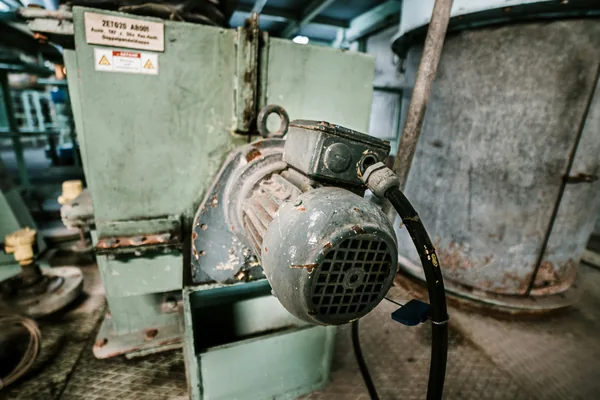
Look for the motor's model and serial number elsewhere – a second tag, the drawings or the purchase records – and ask the motor maker for the data. Don't size a drive from a clamp-meter reading: running current depends on the load that day. In the US, the NEC uses its own full-load current tables for conductors and branch-circuit protection and the nameplate FLA for motor overload protection, so the motor data still matters.
Finding the replacement
An identical drive keeps the mounting, wiring and parameters the same – see PowerFlex 40 to 525 for what changes when it isn't. Every item we stock is photographed, so you can read drive and motor nameplates before you buy. Browse AC drives and VFDs, electric motors and soft starters, or send us the motor nameplate and we'll quote a match. Servo motors follow different rules; see how to read a servo motor nameplate.
Frequently asked questions
Which nameplate current should I use to size a VFD?
The motor's full-load amps (FLA) at the voltage it will run on. Choose a drive whose continuous output current, in the duty rating that fits the load, is at least that figure, and add margin for hard starts or frequent overloads.
What does the service factor mean when a motor runs on a VFD?
Service factor (for example 1.15) is the continuous overload a motor can tolerate on sine-wave power under stated conditions. On a drive, many motor makers advise not relying on it, so size the drive for the full-load current and treat the service factor as margin.
Can I run a 460 V motor from a 480 V drive?
Yes. 460 V is the standard NEMA motor rating for a 480 V system, and a 480 V class drive is the usual match. Enter the motor's nameplate voltage, current, frequency and speed in the drive's motor parameters.
Do I need an inverter-duty motor?
Not always, but it is the safer choice for constant-torque loads at low speed and for long motor leads. Inverter-duty motors have insulation designed for drive voltage spikes and a stated speed range; an older standard motor may need an output filter or reactor.